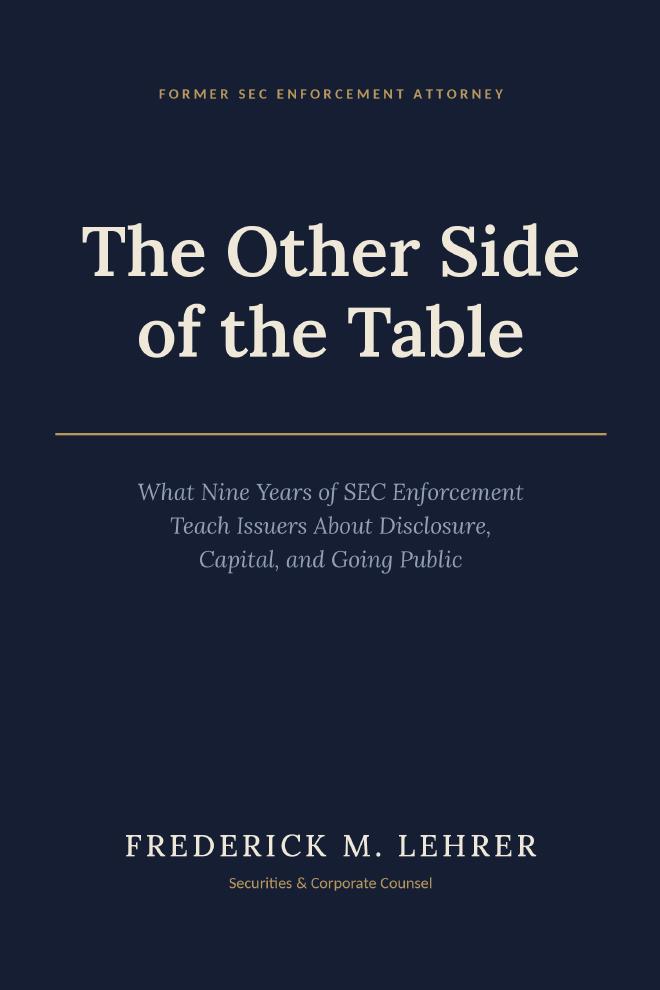
The Other Side of the Table
What Nine Years of SEC Enforcement Teach Issuers About Disclosure, Capital, and Going Public
By Frederick M. Lehrer — former SEC Division of Enforcement attorney (1991–2000) and former Special Assistant United States Attorney, Southern District of Florida (1997–1999).
"Almost none of them started with someone deciding to break the law. They started with someone deciding not to ask."
About the book
Almost every enforcement matter Fred worked on at the Commission had a moment, months or years before anyone at the SEC knew the company's name, when a single phone call would have changed the outcome. The call did not happen.
This book is written for the people who should be making that call: founders, chief executives, chief financial officers, directors, and in-house lawyers of companies that raise capital, go public, or already report to the SEC — and the accountants, bankers, and consultants around them.
It is not a treatise. It shows how the SEC staff reads what you file and what you say, so you can see your own disclosure the way a regulator would — before a regulator does. Each chapter stands on its own: raising money privately, start with Part Two; deciding whether to go public, Part Three; already reporting, Part Four.
Listen and read
Tap a timestamp to jump to that chapter, or open a chapter for its summary, key points, and full text. The complete narration text is on the audiobook page.
Contents
How the Commission Reads
Raising Capital
Going Public
Living as a Public Company
Prefer to listen? Hear the complete audiobook in Fred’s voice. Many chapters are also adapted on the Inside Securities Law podcast, and related analysis appears on the blog.
Recent from the blog
What to Do When the SEC Contacts Your Company
A comment letter, a voluntary document request, and a subpoena are very different things. A former SEC enforcement attorney explains how to tell which one you received, what to do in the first 48 hours, and how to avoid the next one.
How Much Does a Securities Lawyer Cost? Flat Fee vs. Hourly
Hourly securities lawyers bill in six-minute increments, so a one-minute call at $450 an hour costs $45. Here is how securities legal fees actually work, what drives the cost, and why a flat monthly fee changes how companies use their lawyer.
What Is a PPM and When Do You Need One?
A private placement memorandum is the disclosure document for a private securities offering. A former SEC enforcement attorney explains what goes in a PPM, when the law effectively requires one, and the mistakes that turn it into evidence.
Reg A vs. Reg D: Which Exemption Fits Your Raise?
Regulation D is faster and cheaper; Regulation A lets you sell to the general public and creates freely tradable shares. A side-by-side comparison of cost, investors, SEC review, and resale — and how to choose.
General information about U.S. securities law, not legal advice. Reading the book does not create an attorney-client relationship. Attorney Advertising.